ARMY

Warden Platoon
Combined-Arms Jetborne Platoon
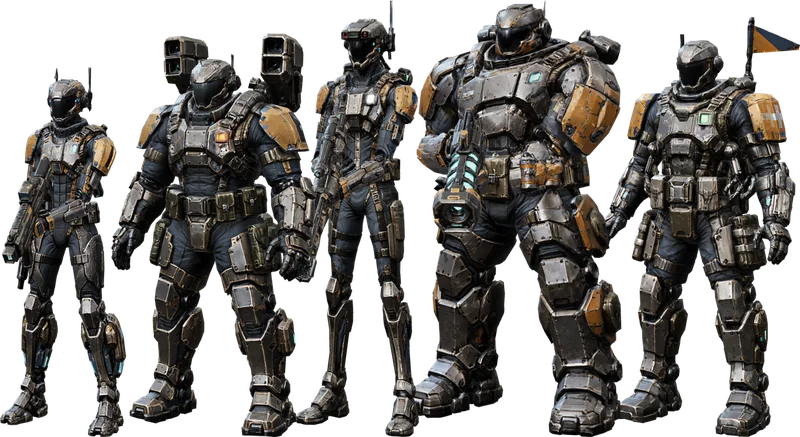
A hard-hitting platoon of 120 2–3 m jetborne soldiers that skim just above terrain. Their tiny target profile and constant lateral jinking make them difficult to hit, yet they remain ground-domain troops rather than true aircraft. Five adaptive rows independently enter their firing bands: the best counter attacks, the longest-range row suppresses, assault guards support, and the support row answers aircraft with anti-air missiles. Far from the fight they fly to range like the frames, airborne while aloft.
01 · Speed
Skimming on its jets
A front-row trooper's jets push 27 kN, 6.1 times its weight: flat out at sea level it reaches Mach 0.53.
02 · Combat
One trooper, and the squad of 120
One trooper at base rank, from the battle sheet; ranks strengthen hull, shield and damage.
03 · Rows
5 rows, each its own trooper and weapon
Front row first, as the platoon draws up. Each row's weapon at base rank: one volley's damage, the seconds between volleys and how far it reaches.
04 · Weapon
Pulse laser
Pulse laser
Rapid pulses, each landing the instant it fires.
Fire cycle · one trooper over 1.9 s
4 an attack every 0.3s: 13 a second. Six attacks land 24 from one trooper, 2,880 from the squad of 120.
Reach against the other units
05 · Available tech
What a commander can fit
Bought mid-battle with supply, for the squad of 120. Each one gives something and costs something.
Core upgrades · 4
Adds a +50% outer targeting band. Attacks, repairs, and boarding channels operate at 55% output beyond native range, and armed squads hold that safer line.
Converts the squad into a breacher: it closes to 45% range and deals +60% damage there, but deals 15% less outside the breach band.
No single hit can strip more than 30% of maximum hull after shields. Mobile units lose 12% thrust; static emplacements lose 18% maximum integrity. Strong into alpha strikes, weak into rapid fire.
Burns at +65% speed while marching or closing on its chosen standoff, then disengages in combat; turn authority is halved during the burn.
Warden Platoon signature tech · 8
Mobile Infantry Platoon links all five rows through jetpack telemetry, improving protection and formation speed without changing its six-stack limit.
Mobile Infantry Platoon enters a protected phased sprint while disengaged; attacking collapses the phase until combat ends.
Mobile Infantry Platoon may deploy on either flank strip and rush inward along an attack lane.
Mobile Infantry Platoon exposes cloaked contacts and marks them for nearby allied attacks.
Mobile Infantry Platoon compresses its attack into a heavier burst followed by a longer reload.
Mobile Infantry Platoon fields 40% more bodies, sacrificing individual protection and output for formation saturation.
Mobile Infantry Platoon prioritizes capital frames and loads a dedicated heavy-target charge for each strike.
Mobile Infantry Platoon scatters autonomous interceptors against guided payloads and light attackers.