NAVY
Thunderhead
Guided-Missile Destroyer · Four-Ship Squadron
Terran Federation destroyer, deployed in four-ship squadrons. Each craft carries 80 missiles: ten eight-round salvos, 386 damage per missile, 6.6 s reload, 40 km/s carrier cruise, 550 m splash and 180 km reach. At 2.5 km from the target envelope, each carrier releases 2 guided rockets at 20 km/s, sharing its 386 damage (193 each). The carrier is consumed without an explosion; carriers and individual rockets remain vulnerable to PD and nearby missile detonations. Its fixed ventral railgun fires one unguided, piercing kinetic slug for 640 damage every 4 s at 20 km/s, out to 140 km. Five laser point-defense mounts per craft protect it: three dorsal and two aft ventral, 60 ordnance damage per emitter every 0.5 s within 2 km. Saturation can overwhelm the screen. Blue-gray armor, orange hazard markings, blue fusion cores and six stern drives.
 Terran
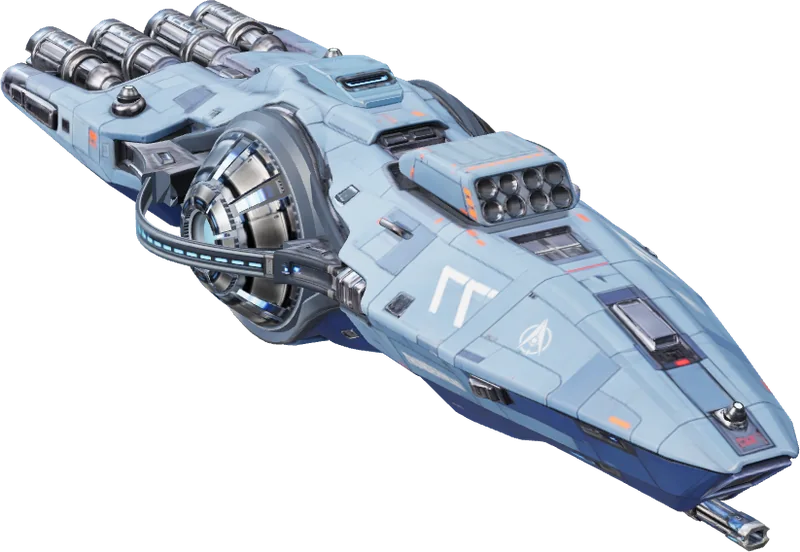
01 · In the line
Against the other destroyers
Speed among destroyers · km/s
Reach among destroyers
At 6 km/s it takes 30 s to close its own reach of 180 km.
02 · Weapon
Eight-tube missile battery and Ventral railgun
Eight-tube missile battery
Dorsal eight-tube launcher · 80 missiles per craft
Each craft carries 80 guided missiles, fired eight per salvo. Ten complete salvos exhaust the magazine; the ventral railgun remains available.
Fire cycle · one hull over 39.6 s
3,088 an attack every 6.6s (8×): 468 a second. Six attacks land 18,528 from one hull, 74,112 from the squad of 4.
Ventral railgun
Fixed ventral barrel · muzzle below the bow
One unguided kinetic slug at 20 km/s. It retains speed and energy between impacts in vacuum. Shields and hull consume its damage budget; only unspent energy continues through a destroyed ship. The 140 km limit is the firing solution, not air drag. No explosive payload or splash.
Fire cycle · one hull over 24 s
640 an attack every 4s: 160 a second. Six attacks land 3,840 from one hull, 15,360 from the squad of 4.
03 · Available tech
What a commander can fit
Bought mid-battle with supply. Each one gives something and costs something.
Core upgrades · 4
Adds a +50% outer targeting band. Attacks, repairs, and boarding channels operate at 55% output beyond native range, and armed squads hold that safer line.
Converts the squad into a breacher: it closes to 45% range and deals +60% damage there, but deals 15% less outside the breach band.
No single hit can strip more than 30% of maximum hull after shields. Mobile units lose 12% thrust; static emplacements lose 18% maximum integrity. Strong into alpha strikes, weak into rapid fire.
Burns at +65% speed while marching or closing on its chosen standoff, then disengages in combat; turn authority is halved during the burn.
Thunderhead signature tech · 8
Martian ordnance engineers stage a heavier follow-through charge behind the first detonation. The eight-tube launcher needs longer to prepare each salvo.
A longer-burning motor carries Star Fleet missile carriers farther and faster. Their terminal rockets retain 20 km/s. Extra propellant displaces part of the warhead; point defense can still intercept both stages.
Supervised fire-control updates improve course corrections for crossing and evasive targets. Added seeker electronics replace explosive payload; forward target recovery and fuel limits remain in effect.
Faster feed drives reload the same eight tubes between salvos. The straight cold-ejection sequence is retained; the shield grid gives up reserve power to the loading machinery.
Pre-scored casings spread the detonation across a wider formation. Less explosive mass remains for the direct strike.
Timed pulse fuzes concentrate the detonation against a deflector field. Their smaller main charge hurts exposed hulls less; shields are damaged rather than bypassed.
Terran Aegis capacitor practice expands the existing shield grid. The six main drives surrender part of their power budget to keep the reserve charged.
Star Fleet assault doctrine favors quick strikes and rapid repositioning. Drive and attitude-jet upgrades make the destroyer more agile, while a reduced fire-control budget shortens missile engagement range.