NAVY
Breacher
Beam Frigate · Four-Ship Squadron
Trinity Union Breacher frigate, four ships abreast. Each ship has 4,571 total protection split into 914 hull HP (20%) and 3,657 shield (80%), rounded to whole points, and travels at 16 km/s. Its original-FBX forward gun emits one single-target beam out to 45 km, with no splash and a ground-only target domain. It prioritizes destroyers and larger hulls, falling back to the nearest target when none are in reach. The first contact hit deals 2 damage. Further hits occur every 0.2 s, doubling during uninterrupted contact until capped at 2,604 damage per hit (13,020 peak DPS), first reached at 2.4 s. Changing targets or losing contact resets the ramp to 2. Squadron cost 200, unlock cost 0 and upgrade EXP 1,000. Optional Trinity hull technologies and core refits can be fitted to the squadron. The 90 m dock length follows the provisional frigate class default.
 Trinity
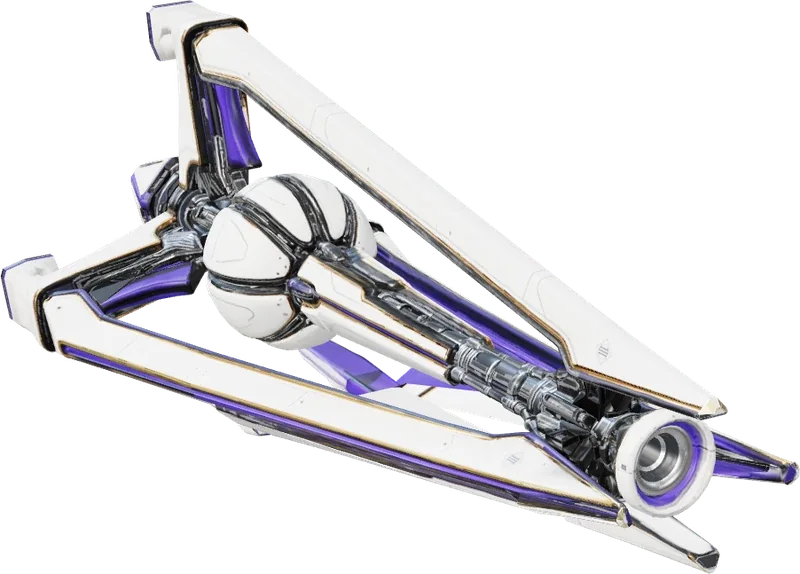
01 · In the line
Against the other frigates
Speed among frigates · km/s
Reach among frigates
At 16 km/s it takes 2.8 s to close its own reach of 45 km.
02 · Weapon
Beam emitter
Beam emitter
A continuous beam: its damage is dealt every second it holds its lock.
Spin-up · damage a second over a 4.1 s lock
A lock held for 4.1 s lands about 30,742. Break the lock and it climbs again from a flicker.
03 · Available tech
What a commander can fit
Bought mid-battle with supply. Each one gives something and costs something.
Core upgrades · 4
Adds a +50% outer targeting band. Attacks, repairs, and boarding channels operate at 55% output beyond native range, and armed squads hold that safer line.
Converts the squad into a breacher: it closes to 45% range and deals +60% damage there, but deals 15% less outside the breach band.
No single hit can strip more than 30% of maximum hull after shields. Mobile units lose 12% thrust; static emplacements lose 18% maximum integrity. Strong into alpha strikes, weak into rapid fire.
Burns at +65% speed while marching or closing on its chosen standoff, then disengages in combat; turn authority is halved during the burn.
Breacher signature tech · 8
The three minds of the Trinity solve the focusing sequence in parallel. The first capped hit arrives at 1.6 seconds instead of 2.4; a conservative output limit protects the accelerated optics.
Knowledge from Trinity phase-weave screens tunes the lance against an enemy shield’s harmonic structure. The beam breaks the field rather than bypassing it, at reduced output against bare hull.
Synthetic optical processors keep the particle-beam column coherent farther from the bow. The narrower power budget carries less energy into each hit.
Trinity Collective Cells synchronize their discharge into the original forward cannon. Shield capacitors surrender reserve power to sustain the stronger lance.
Reserve lattice cores follow the White Accord’s doctrine of layered protection. Charging the larger screen leaves less reactor output for the four existing drives.
A Synth-Core predicts the attitude corrections needed to hold the fixed bow cannon on a crossing target. Hive-Servos improve turning and flight speed; the shield grid funds their power draw.
Neural-Alloy reinforcement and Synthetic Weave armor protect the frame beneath its shield. The heavier hull preserves the original silhouette but slows the frigate; it does not regenerate in combat.
Cached focusing solutions seed every fresh lock above the weakest opening charge. The opening hit becomes 6.8 before other upgrades, while the reserved compute and power reduce peak output. Losing contact still resets the lock.