NAVY
Hunter
Fusion Cruiser · Minelayer · Single Hull
Ultra Consortium Hunter cruiser (minelayer), one 360 × 200 × 90 m hull of about 389 kt. Twin fusion burst cannons alternate one 25 kg shell every 0.6 s (827 damage/s), from a finite 1,000-shell magazine shared by both banks. Predictive aim leads the target before release; proximity-fused shells fly straight at 40 km/s, reaching 80 km in 2 s, and never track. Each 1.3 kt antimatter-lit fusion warhead deals 496 damage inside 1.75 km, falling by inverse-square to about 61 at 5 km, including friendly ships. No firing inside 6.25 km. No point defence. A 590 GW core uses a 5.9 µg antimatter igniter; full gunfire draws about 83 GW and sheds 50 GW through the limb ribs. Shields draw about 0.2 GW, leaving about 505 GW for engines and systems. One thousand loaded shells provide ten minutes of continuous firing cycles and weigh 25 t. Each carries a sealed fusion payload and 1 µg antimatter ignition charge: 1 mg across the 1,000-shell magazine, separate from the ship’s 5.9 µg reactor igniter. An empty cannon magazine stops gunfire; the drone bays keep their independent supply. Both bays launch together: two guided suicide-drone mines every 15 seconds, one from each bay. Each drone flies at 16 km/s, has 144 hull HP + 576 shield (720 total protection) and deals 2,500 damage to hostile hulls within a 1.2 km blast radius; damage increases by 18% of base damage per carrier rank (+450), while hull HP and shield remain fixed at every rank. Each drone micro-core carries 1 µg of antimatter, fixed across ranks: 6 µg for six base drones or 8 µg for eight with Expanded Mine Racks, separate from shell ammunition and the ship reactor igniter. An internal micro-core powers the personal shield and detonates on attack impact. PD drains the shield before damaging the hull. Launch range is 1.5–180 km with a 240 km travel limit. Each ship carries six drones (three paired salvos); Expanded Mine Racks raises capacity to eight, the maximum. Rapid Launch Cycling reduces the salvo interval from 15 to 12 seconds. Finite magazines refill on redeployment, with no combat resupply. Ship point defence can intercept drones; shot-down and exhausted drones disarm.
 Ultra
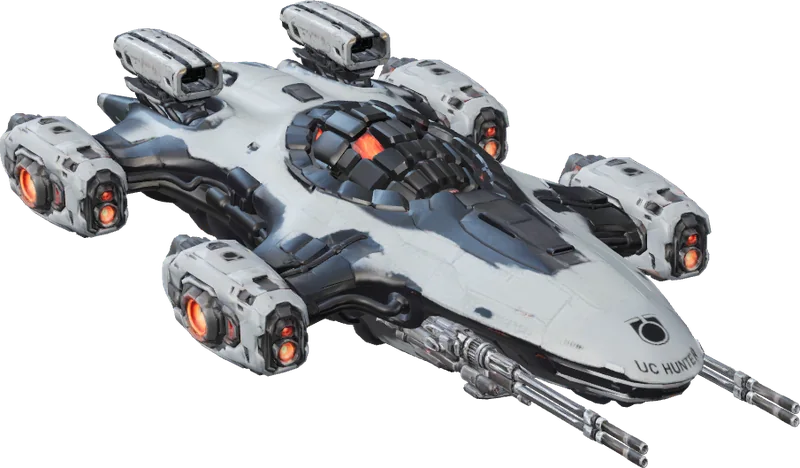
01 · In the line
Against the other cruisers
Speed among cruisers · km/s
Reach among cruisers
At 8 km/s it takes 10 s to close its own reach of 80 km.
02 · Weapon
Twin fusion burst cannons
Twin fusion burst cannons
Two fixed cannon banks · alternating one shell every 0.6 s
Unguided 25 kg shells with 1.3 kt antimatter-lit fusion warheads. Predictive aim and proximity fuse; 496 damage inside 1.75 km, inverse-square to about 61 at 5 km. Friendly fire; no firing inside 6.25 km. A finite 1,000-shell magazine is shared by both cannon banks: ten minutes of firing cycles, 25 t of loaded shells. Each round has its own sealed 1 µg antimatter igniter: 1 mg per full magazine, separate from the ship’s 5.9 µg reactor reserve. No combat resupply.
Fire cycle · one hull over 3.6 s
496 an attack every 0.6s: 827 a second. Six attacks land 2,976 from one hull.
03 · Available tech
What a commander can fit
Bought mid-battle with supply. Each one gives something and costs something.
Core upgrades · 5
Adds a +50% outer targeting band. Attacks, repairs, and boarding channels operate at 55% output beyond native range, and armed squads hold that safer line.
Converts the squad into a breacher: it closes to 45% range and deals +60% damage there, but deals 15% less outside the breach band.
No single hit can strip more than 30% of maximum hull after shields. Mobile units lose 12% thrust; static emplacements lose 18% maximum integrity. Strong into alpha strikes, weak into rapid fire.
Burns at +65% speed while marching or closing on its chosen standoff, then disengages in combat; turn authority is halved during the burn.
Adds 250 shield. If at least 25% charged, a breaking hit loses all hull overflow; the gate re-arms only after recharge reaches 25%.
Hunter signature tech · 2
Additional internal racks carry two more micro-core drone mines. Both bays still release one drone together per salvo.
Synchronized bay actuators and micro-core charging shorten the interval between paired drone launches.