NAVY
Saber
High Damage Cruiser
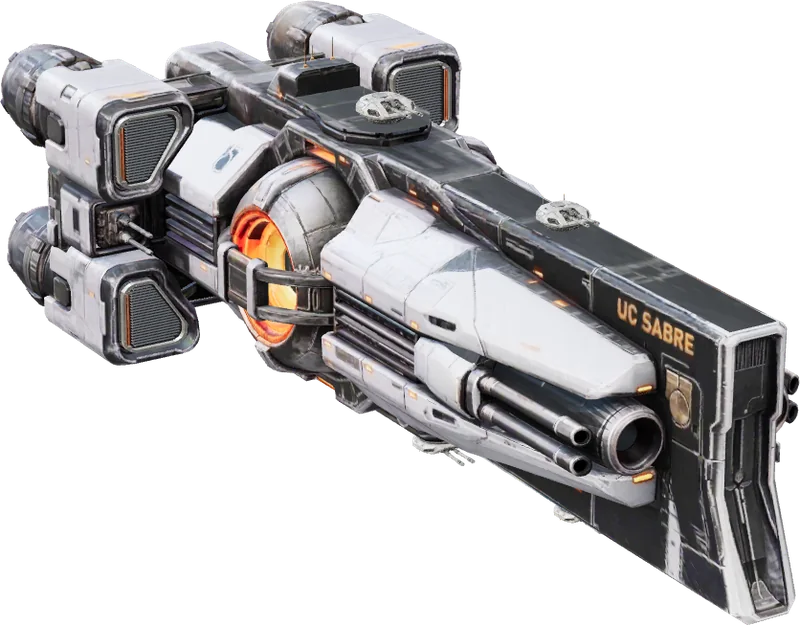
Ultra Consortium combat cruiser, 300 m long: the UC Sabre hull at twice its former destroyer dimensions. Its two forward Casaba howitzer bores alternate one unguided plasma jet every 3.2 s: 7,400 damage, 280 km/s, full strength to 90 km and inverse-square falloff to 127 km. It leads moving targets and penetrates destroyed hulls with the damage that remains. Sixty directional detonation charges are shared between the two main bores; each charge detonates inside a reaction chamber to produce the directed plasma jet. Two twin secondary laser mounts fire four 500-damage beams to 95 km: 2,000 damage after two seconds of maintained tracking, with exposures starting every six seconds. They use no Casaba charges. Four Medium-class twin-barrel point-defense turrets intercept hostile ordnance within 3 km, dealing 180 damage per shot with an independent 0.5 s recharge. Its main cannon prioritizes the highest ship class within firing range, then the nearest target within that class.
 Ultra
01 · In the line
Against the other cruisers
Speed among cruisers · km/s
Reach among cruisers
At 6 km/s it takes 21 s to close its own reach of 127 km.
02 · Weapon
Casaba howitzer and Twin tracking laser systems
Casaba howitzer
Two flank howitzers in the prow · magnetic reaction chambers, a bore at a time
The two forward bores alternate, firing one unguided plasma jet every 3.2 s. A directional charge detonates inside the reaction chamber, which focuses the blast into the jet. Each shot deals 7,400 damage at 280 km/s: full strength to 90 km, then inverse-square falloff to its 127 km reach. Fire control leads moving targets; the jet never homes. The shared magazine carries 60 charges. One charge is detonated per main-gun shot; both bores draw from this supply. A charge of 608 kg of TNT goes off in the bore's magnetic reaction chamber: its X-rays boil a propellant plug to plasma, and the field throws 50% of the burst forward as a jet of 32 g at 280 km/s, white-hot at its head and stretching behind it. It spreads 0.33 milliradians from its line, so it stays on a 60 m hull out to 90 km. It lands 1.27 GJ, 304 kg of TNT, and pushes back about 9,100 newton-seconds, nothing to a ship. At 39 GJ a kilogram, about 5,200 times what boils steel, it bursts on the plate: it boils some 84 kg and throws the vapour out at 3.9 km/s, a flash 23 m across, over in 3 ms. Only what soaks all of it stops it: a ship whose shield and plate give out first, it goes through, and flies on with what they did not take into whatever stands next on its line. The other 1.27 GJ stays in the liner: the bore glows, and some 85 kg of deep-cold clathrate melt and boil to take it up, blown out hot through the gills behind the howitzer.
Fire cycle · one hull over 19.2 s
7,400 an attack every 3.2s: 2,313 a second. Six attacks land 44,400 from one hull.
What lands · by distance as its jet spreads
Its jet spreads as it flies, in air as in vacuum: whole to 90 km, then less by the square of the distance.
Twin tracking laser systems
Two flank twin mounts · four original small barrels
4 simultaneous beams from two twin mounts. Each beam delivers 500 damage after 2 seconds of maintained contact (2000 total), out to 95 km. Exposures begin every 6 seconds; lost aim or line of fire reduces delivered damage. These lasers use no Casaba charges.
Fire cycle · one hull over 36.1 s
2,000 an attack every 6s: 333 a second. Six attacks land 12,000 from one hull.
03 · Available tech
What a commander can fit
Bought mid-battle with supply. Each one gives something and costs something.
Core upgrades · 5
Adds a +50% outer targeting band. Attacks, repairs, and boarding channels operate at 55% output beyond native range, and armed squads hold that safer line.
Converts the squad into a breacher: it closes to 45% range and deals +60% damage there, but deals 15% less outside the breach band.
No single hit can strip more than 30% of maximum hull after shields. Mobile units lose 12% thrust; static emplacements lose 18% maximum integrity. Strong into alpha strikes, weak into rapid fire.
Adds 250 shield. If at least 25% charged, a breaking hit loses all hull overflow; the gate re-arms only after recharge reaches 25%.
Burns at +65% speed while marching or closing on its chosen standoff, then disengages in combat; turn authority is halved during the burn.
Saber signature tech · 8
Fires a 4s frenzy at a 1.2s cycle, then locks out for 3s to cool the predator feed.
Saber gains a much longer firing envelope but cannot engage inside its new dead zone.
Saber prioritizes capital targets and loads a devastating heavy-hull shot at a slower cadence.
Saber walks two more rounds into every salvo (3 on its own sheet), then enters an extended reload.
Saber fire becomes an instant rail lance through every hull aligned behind the first target; its rounds no longer burst on the mark.
Saber converts its impact into a shaped falloff zone; beams create a focal burn field.
Saber raises a narrow forward shield against return fire; flanking shots bypass it.
Saber reveals cloaked attackers and marks them for nearby allied fire.